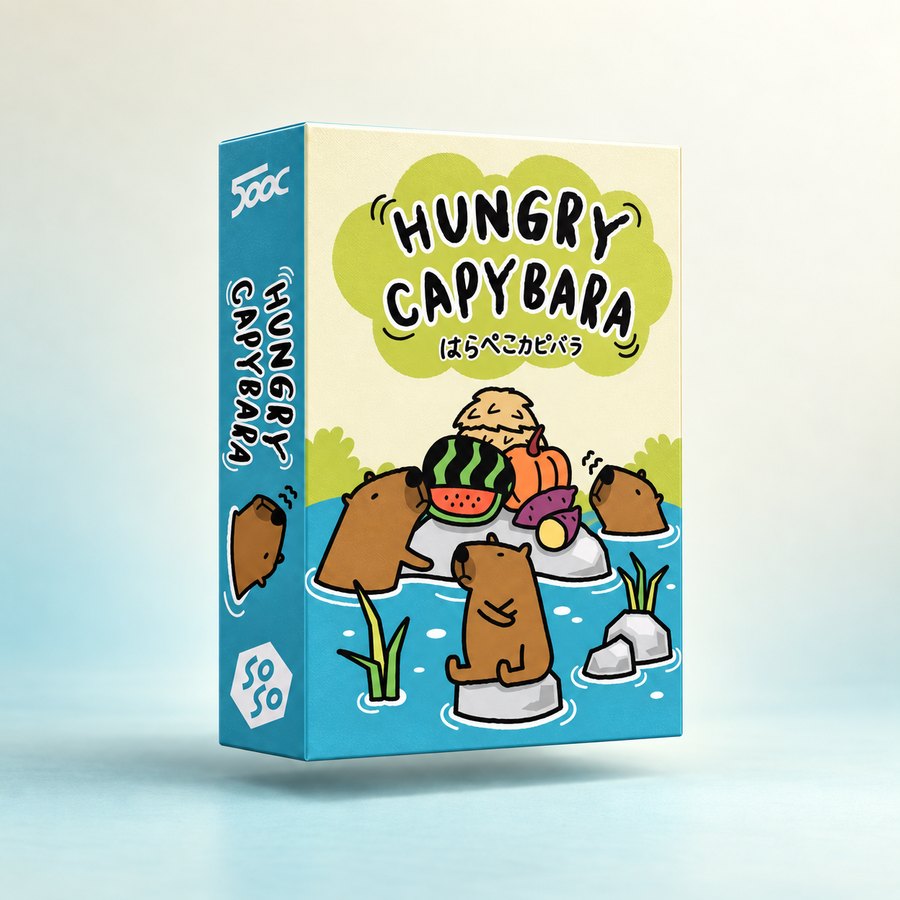
Hungry Capybara
好餓的水豚
Capybaras eat anything — but never the same thing twice. Fill the plates on the card and the animal leaves full.
- Year
- 2026
- Players
- 2-5
- Play time
- 20 min
- Age
- 8+
- The whole rule in one line: no animal, play one; animal waiting, feed it
- Every bite a capybara takes must be a different food, so duplicates clog your hand
- The Picky Capybara only eats Branches and Hay, but will happily eat them twice
- Six Other Animals fire an ability when fed: reverse the order, pick the next player, everyone swaps cards
- Cards left in hand cost you: −1 per Food card, −2 per Animal card
- Two rounds decide it, about 20 minutes, ages 8 and up
Hungry Capybara is a light card game for 2 to 5 players. The capybaras at the zoo are starving, and you and the other visitors take turns feeding them. The moment somebody empties their hand, the round is over.
There is only one rule to remember: if no animal is out, play an Animal card; if an animal is waiting, feed it a Food card it can eat. Once the Food cards match the plates on the animal, it leaves full. Anyone who cannot feed has to draw, and their hand only gets heavier.
The catch is that capybaras are fussy. They will eat anything, but never the same food twice. A capybara with three plates that has already eaten Watermelon and Hay needs something else for its third card — which is exactly how a fistful of Hay ends up stuck in your hand.
Goal
The game lasts 2 rounds. Whatever is still in your hand when a round ends becomes negative points, so the aim is to feed your cards away as fast as you can.
After both rounds, the player who lost the fewest points wins. On a tie, play one more round until a single winner emerges.
Setup
- Shuffle all the cards and put them in the middle of the table as the draw pile. Leave room beside it for the discard pile.
- In your first game you can leave the Other Animals out, and add them once everyone knows the rules.
- Deal by player count: 2–3 players get 8 cards each, 4 players get 6, 5 players get 5.
- Whoever fed an animal most recently starts, or else the youngest player. Play goes clockwise.
Food and Animal cards
The number on a Food card is both its type and how many copies exist: 1 Apple, 2 Pumpkin, 3 Carrot, 4 Sweet Potato, 5 Watermelon, 6 Branch, 7 Hay. Hay is the most common, Apple the rarest. 28 Food cards in all.
The plates printed on an Animal card are how many Food cards it needs to be full. There are 14 Animal cards, 8 of them capybaras.
- Capybara: every Food card it eats must be a different type. One with three plates that has eaten Watermelon and Hay needs a third, different food.
- Picky Capybara: eats only Branches and Hay, and may eat the same one more than once.
- Other Animals: a single plate, they eat anything, and fire an ability when fed.
On your turn
When the Food cards match the plates, the Animal card and its food go to the discard pile together. If it was an Other Animal, use its ability first, then discard.
- Play a card: with no animal out, play 1 Animal card; with an animal waiting, play 1 Food card it can eat and put it beside the Animal card.
- Pass: if you cannot play, draw 1 card from the draw pile.
Other Animal abilities
- Muntjac: turn order reverses.
- Shiba Inu: everyone says whether they hold an Animal card.
- Macaque: everyone discards 1 card from hand.
- Sika Deer: you choose who takes the next turn, then play continues from them in the same direction.
- Cat: everyone simultaneously takes 1 random card from the player on their right.
- Alpaca: everyone simultaneously picks 1 card and passes it to the player on their left.
Ending a round and scoring
A round ends immediately when a player empties their hand (including losing their last card to an ability), or when someone must draw and the draw pile is empty.
Each Food card in hand is −1, each Animal card −2. A player who emptied their hand scores 0, and cards on the table do not count. Two Hay and one Macaque left in hand, for instance, is −4.
Gather every card including the discard pile, reshuffle and start the next round, beginning with the player to the left of whoever ran out.