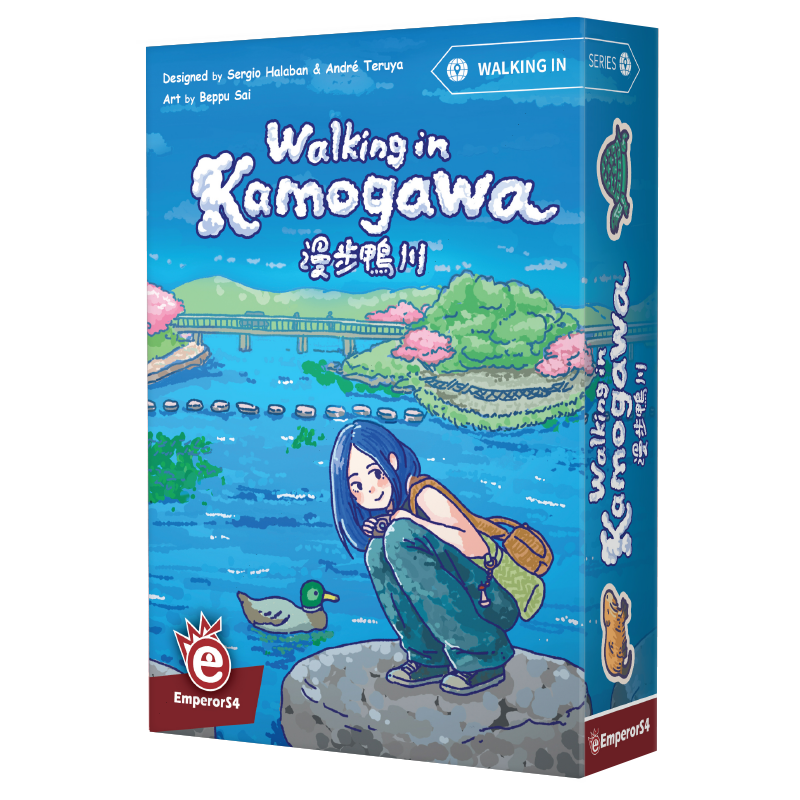
Walking in Kamogawa
漫步鴨川
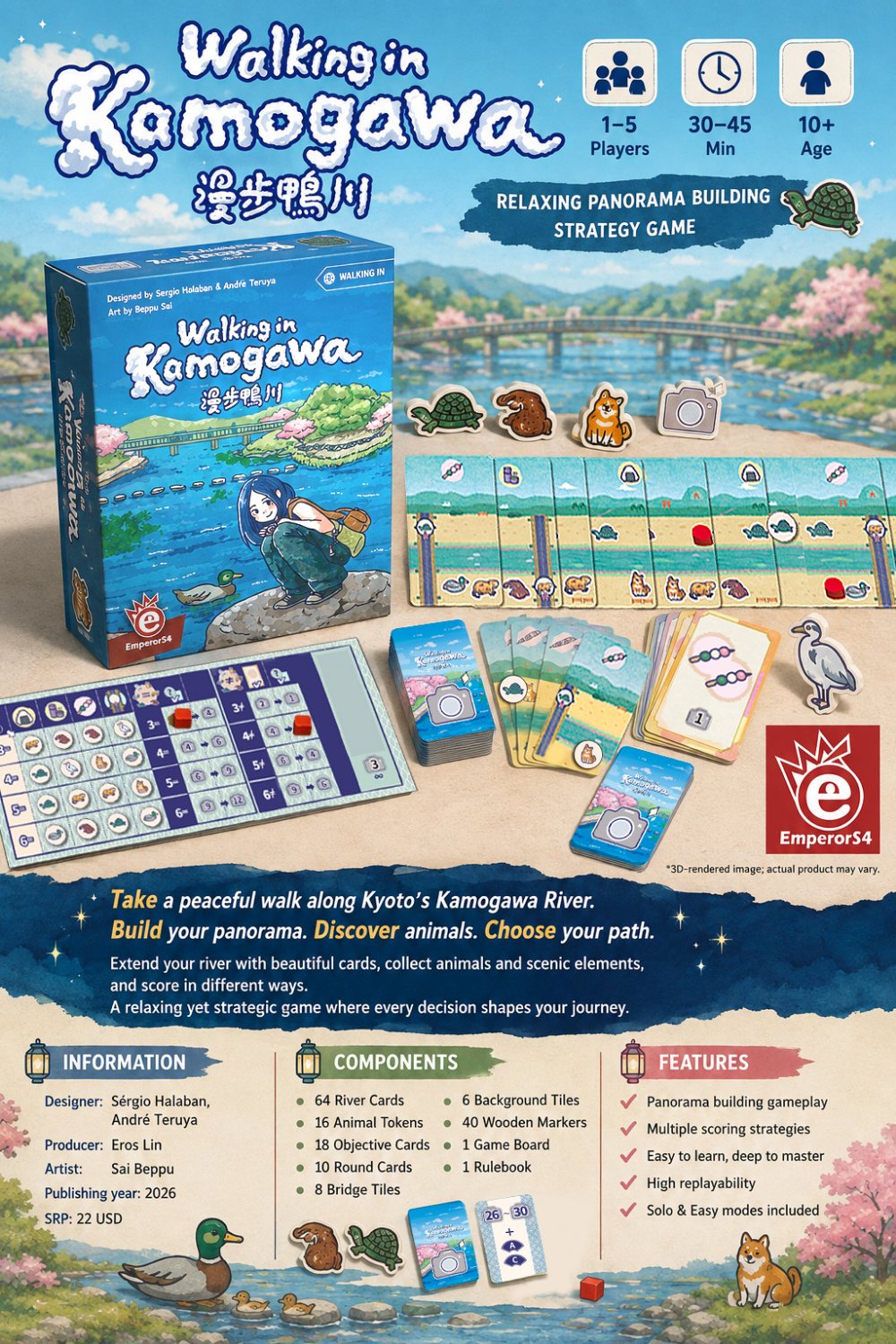
Stroll along Kyoto's Kamogawa and piece the four seasons into a panorama that is yours alone.
- Year
- 2026
- Item no.
- EMPWIKR
- Players
- 1-5
- Play time
- 30-45 min
- Age
- 10+
- Designer
- Sérgio Halaban, André Teruya
- Artist
- Sai Beppu
- Overlapping cards: every card you play rewrites scenery you already built
- Three ways to score, one choice per turn — the trade-off is the game
- A pushing mechanism on the board: take the good spot, or get pushed to a better one
- Standard, simple and solo modes included; solo challenges you to reach 50 points
Flowing through Kyoto, the Kamogawa has shaped the city's seasonal scenery for centuries. Clear water, long open riverbanks, old townhouses and bridges — this is where locals and travellers alike come to walk.
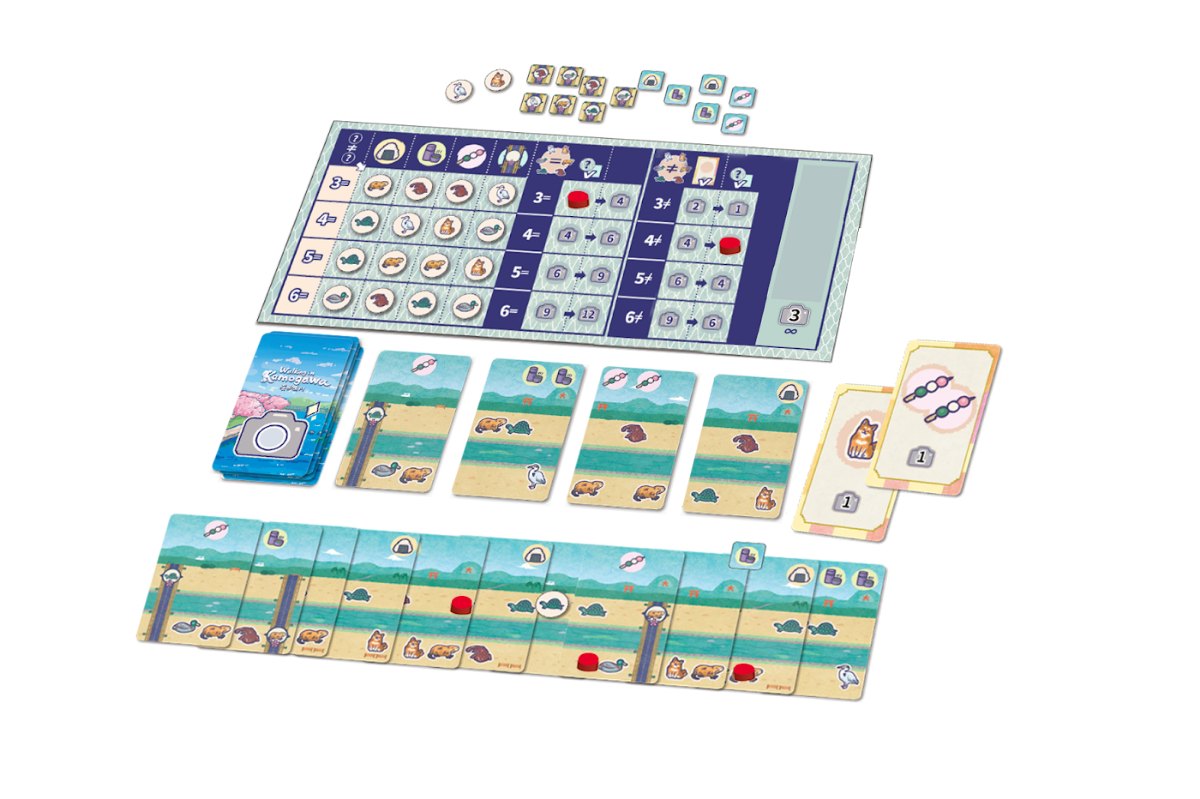
In Walking in Kamogawa, you embark on this leisurely walk along the riverbank, capturing the shifting scenery into a magnificent, continuous panorama. By carefully selecting and overlapping River Cards, you will build your own unique vision of the riverside.
As you extend your panorama, you can begin to score by taking pictures of the scenery. There may be lots of different animals, or a gathering of the same type, or simply a background that appeals to you. The challenge is how to compose the panorama so that it maximises your scoring conditions — and wins.
Goal
Walk the Kamogawa and build your panorama from 11 River Cards. The game lasts 10 rounds; at the end you score the animals named on the bridges, your goal cards, your markers on the board and your round cards. Highest total wins.
Components
- 1 double-sided board
- 64 River Cards
- 10 round cards
- 16 goal cards
- 18 animal discs
- 6 background tiles and 8 bridge tiles
- 40 player markers (8 each in 5 colours)
Turn Overview
Starting with the first player and going clockwise, take two actions on your turn:
- Walk the riverbank (mandatory) — draw one card from the four on display or from the top of the deck, and play one River Card, extending your panorama to the left or to the right. You may draw and play in whichever order you prefer.
- Score (optional) — choose one of the three scoring actions and carry it out, gaining its bonus. You may also choose not to score at all.
Placing River Cards
- A panorama only ever grows to the left or the right; you may never insert a card between two existing cards.
- Each card you place must cover at least one icon (an animal or a background). The new card may cover the old one, or slide underneath it.
- If the new card covers an animal disc, pick the disc up and place it back onto the same position on top of the new card.
Three Ways to Score
A count of 3, 4, 5 or 6 animals places your marker on the matching space, worth 2, 4, 6 or 9 points at the end of the game. If the space you want is taken, you may push the other player's marker to the right — and a marker that gets pushed ends up worth more, which makes for an enjoyable tug of war.
- Picnic / Sightseeing — count how many of one background type (rice ball, dango, tea) appear in your panorama, place a marker on the matching space of the board, and take the animal disc from that space. Each background type may only be scored once per player.
- Matching animals — choose a stretch of path that has not been scored yet and count the animals that are identical and consecutive. Place a marker and immediately take one bonus disc or tile.
- Different animals — again choose an unscored stretch of path, and count the animals that are of different types and consecutive. Place a marker, then draw 2 goal cards and reveal 1 of them.
End of the Game and Scoring
After 10 rounds each player has 11 River Cards in front of them and the game ends. Score as follows:
- Named animals — for the animal shown on a bridge, score 1 point per animal of that type along the same path.
- Goal cards — 1 point per shiba inu; 1 point per 2 rice balls, dango or tea.
- Board scoring — backgrounds, matching animals, different animals and the 3-point rightmost zone, scored by where your markers sit.
- Round cards — holding 6 / 5 / 4 / 3 cards is worth 12 / 9 / 5 / 2 points (agree before the game whether to use them).
Other Modes
- Simple mode — flip the board, use only the River Cards, and score your panorama directly at the end. Faster and lighter.
- Solo mode — start from a 30-card deck and try to reach 50 points by assembling the scoring elements. Fall short and the back of the round cards grants you a bonus for your next attempt.
Gallery