Isle of Bears
熊之島
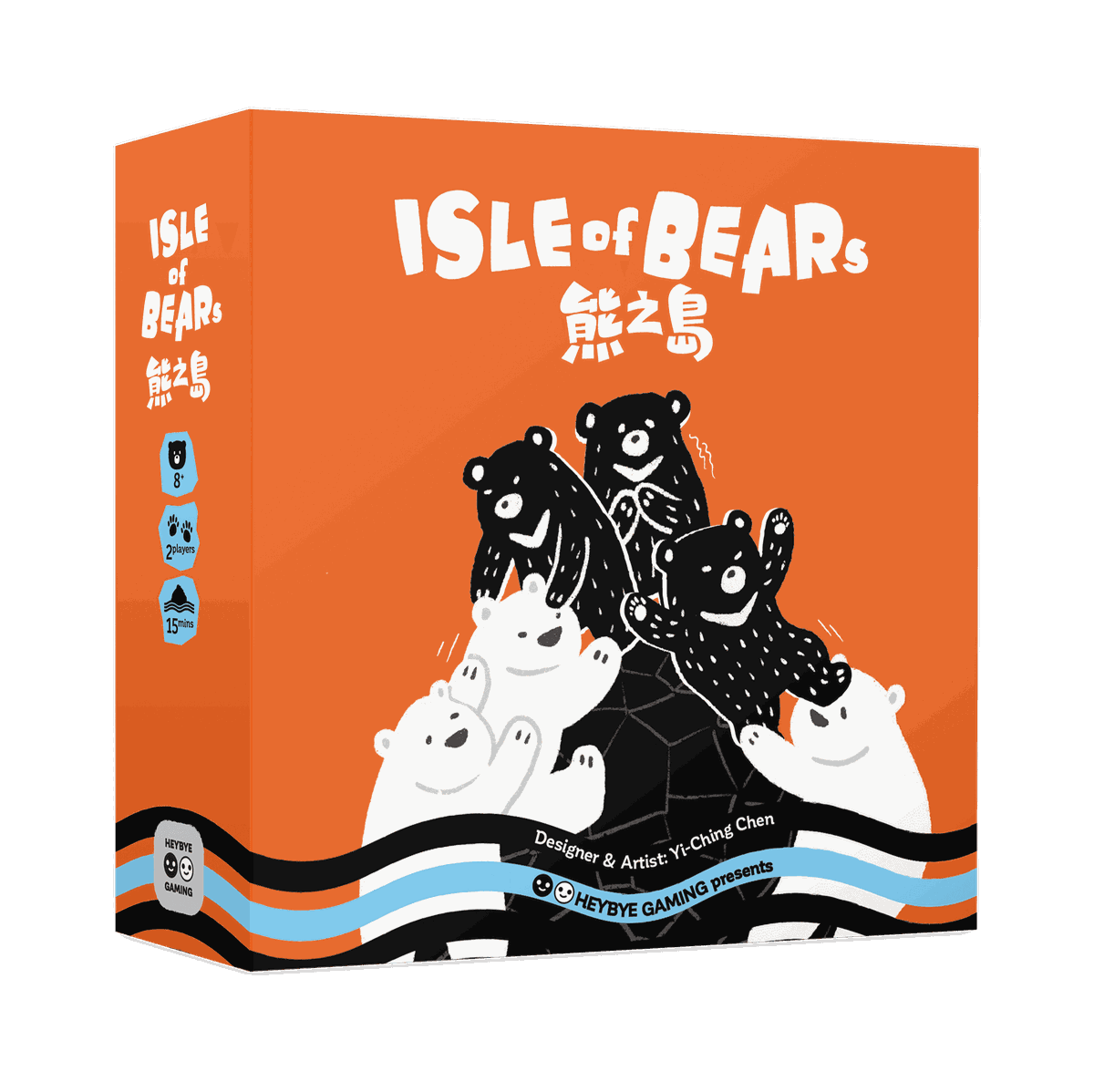
The Arctic has run out of ice, so the white bears have climbed onto the black bears' isles. There is not enough room for everyone — and the bear on top of the pile is the one in charge.
- Year
- 2026
- Players
- 2
- Play time
- 15 min
- Age
- 8+
- Designer
- Yi-Ching Chen
- Artist
- Yi-Ching Chen
- Two players, 15 minutes, and a rules explanation that takes about five
- The top bear controls the stack — the bears you trap underneath are your strength, not your problem
- Five bears fit safely on a space; a sixth pushes every one of your opponent's bears into the sea
- Bears lost to the sea never come back, and an isle left empty sinks — the board keeps shrinking
- 13 cards covering 11 effects: Straight, Party, Push, Dismiss and Banish each demand a different plan
- Victory can trigger at any instant, including in the middle of your opponent's turn
Every summer will be the coolest summer of the rest of your life. Summer, 2050: the Arctic Ocean is nearly ice-free. The displaced white bears drift across the sea, discover the black bears' isles and happily climb aboard. But there is not enough room for everyone, and the battle for the Isle of Bears begins.
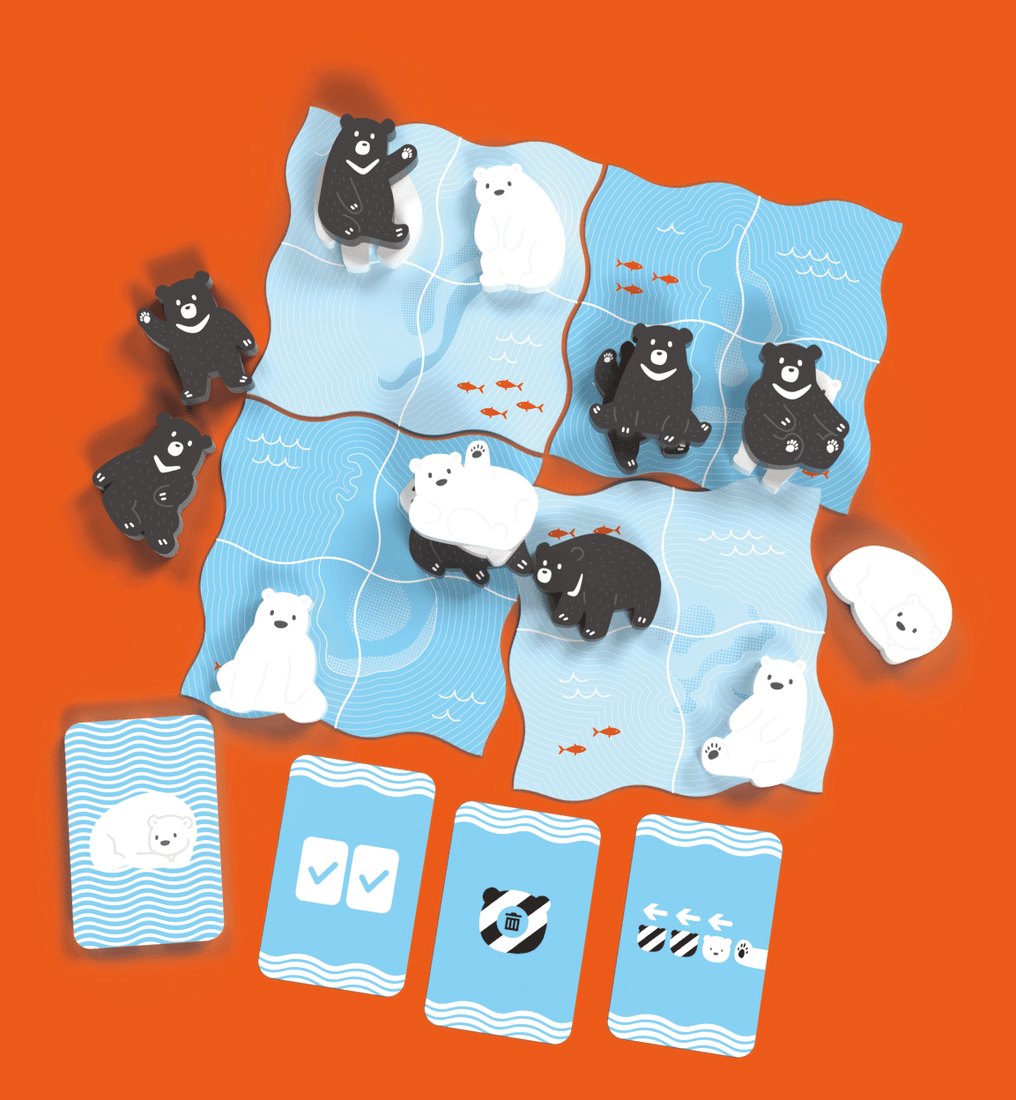
Isle of Bears is a two-player, card-driven board game. Four isles lock together into a 4×4 grid of 16 spaces, with 16 bears scattered across it. You always have 3 cards face up in front of you; each turn you pick one and use it to move bears, stack them, or simply drop them into the sea.
Bears stack, and whoever owns the top bear controls the entire stack — so this is not a game about removing your opponent, it is a game about sitting on top of them. The moment every occupied space is topped by the same colour, that colour wins on the spot.
Goal
Play cards to move, stack and remove bears, getting your own bears on top so you control every bear in that space.
At any time, if the top bear on every occupied space is the same colour, the player of that colour immediately wins.
Components
- 4 isles (locked together into the 4×4, 16-space play area)
- 8 black bears and 13 black bear cards (the black player)
- 8 white bears and 13 white bear cards (the white player)
Getting ready
- Put the 4 isles together in a square to make a 4×4 grid of 16 spaces. Spaces on different isles that share an edge are still adjacent.
- Mix up all 16 bears and place one bear on each space.
- Each player chooses a colour, takes the 13 matching cards, shuffles them into a deck and turns 3 of them face up in front of them.
- Both players snap their fingers at the same time. The louder snap goes first.
Three rules that always apply
These three things hold whenever a card effect resolves. Learn them and every card explains itself:
- Stack & control: bears can share a space and form a stack. If the top bear is your colour, you control the entire stack.
- Act together: card effects apply to all bears in a space as one group, however many are there.
- Falling into the sea: anywhere without an isle is the sea. Bears can only remain on isles, and any bear that falls into the sea is permanently removed.
Playing a turn
Players take turns. On your turn, resolve the following four steps in order:
- ① Play a card: choose one of the 3 face-up cards in front of you and resolve its effect.
- ② Overcrowding: check the bears. A space can safely hold up to 5 bears. If a space contains 6 or more, send all of your opponent's bears in that space into the sea (permanently removed). Only your bears remain.
- ③ Sinking isles: check the isles. If an isle has no bears on it, rising sea levels cause it to sink. Permanently remove that isle from the game.
- ④ Discard & draw: discard all cards you used this turn, then refill to 3 cards. If your deck runs out, shuffle the discard pile to form a new deck.
Winning
At any time, if the top bear on every occupied space is the same colour, the player of that colour immediately wins the game — no need to wait for the end of a turn, and it can just as easily happen during your opponent's.
What the cards do
Each player has 13 cards covering 11 effects: two Straights and two Diagonals, one of everything else. Shown here as black bear cards; the white bear cards work the same with the colours reversed.
- Straight ×2: move a stack of bears you control to any other space in a straight line up, down, left or right. There is no distance limit, and the bears may pass over other bears.
- Diagonal ×2: move a stack of bears you control to any other space diagonally. There is no distance limit, and the bears may pass over other bears.
- Leap: move a stack of bears you control to any other space.
- Swap: swap all the bears between any two spaces.
- Party: choose a stack you control. Move all bears from the four orthogonally adjacent spaces onto that stack. You choose the stacking order.
- Push: move a stack you control 1 space in any direction, including diagonally. Any stacks directly in its path are pushed 1 space too. Bears pushed into the sea are permanently removed.
- Dismiss: pick up a stack of bears you control and place them one by one, starting from the bottom. Place the first bear adjacent to the original space (diagonals count), then each next bear adjacent to the previously placed bear. Bears may stack. Continue until no bears remain in your hand.
- Banish: choose any space and send all bears on that space, regardless of colour, into the sea. They are permanently removed from the game.
- Play Twice: resolve two other face-up card effects in front of you — either two different cards once each, or the same card twice. Then discard all cards used.
- Forced Discard: choose one of your opponent's face-up cards and discard it. On their next turn, they can only play from the remaining cards.
- Wild: choose any other face-up card in front of either player and resolve its effect. If it is your opponent's card, reverse all black and white references. Discard each used card to its owner's discard pile.
Gallery